



For premium faucet brands, material selection is no longer just a cost decision—it is a compliance, performance, and brand-positioning decision. Zinc Alloy offers strong advantagesin die-cast faucet components, including precise geometry, efficient tooling economics, excellent plating adhesion, and competitive unit costs. Yet its role must be carefully defined because potable pressurized waterways are governed by strict standards such as NSF/ANSI 61, cUPC, and lead-free regulations. This article explains how procurement and product teams should specify Zinc Alloy Faucet parts, when to choose hybrid construction, what design data an OEM needs, and which commercial benchmarks—MOQ, lead time, wall thickness, tooling life, and porosity—matter most for reliable manufacturing.
How Huazhu Manufactures Customized Zinc Alloy Faucets
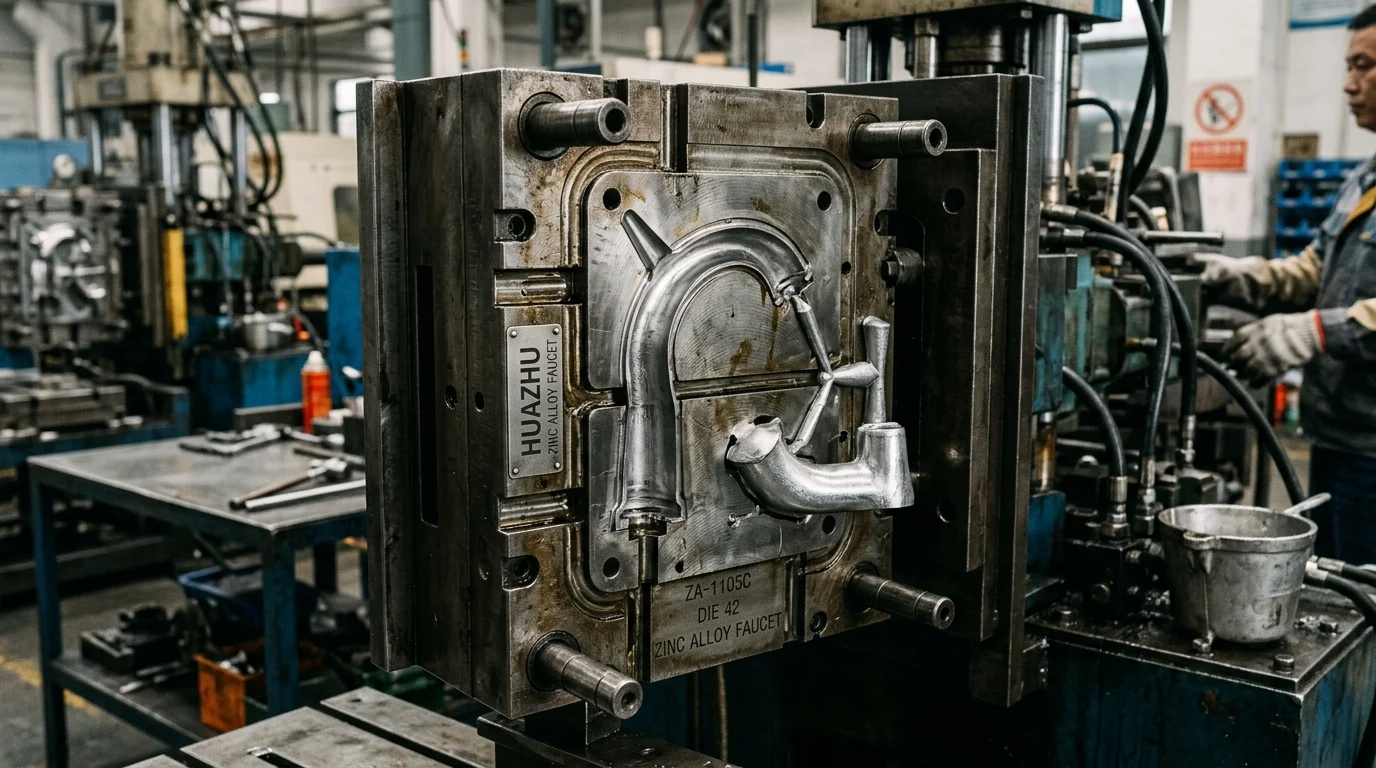
Transitioning from general procurement principles to practical application, Huazhu serves as an illustrative case study of a specialized OEM/ODM manufacturer utilizing an integrated production approach for bathroom and kitchen hardware. By managing multiple manufacturing phases internally, the facility reduces the quality risks often associated with heavily subcontracted supply chains.
The company's portfolio encompasses basin faucets, kitchen faucets, water purifier faucets, and custom handles. Delivering these products to high standards requires strict control from raw material processing to final assembly, particularly when producing hybrid faucets that pair zinc exterior shells with compliant internal waterways.
Mold Making, Die Casting, CNC Machining, and Polishing
The manufacturing lifecycle begins with precision mold making, utilizing advanced EDM and wire-cutting equipment to craft high-durability steel dies. Once tooling is validated, production moves to high-pressure die casting. Typical facility capabilities include automated die-casting machines ranging from 160T to 400T clamping force, which ensure high-density compaction of the Zinc Alloy to minimize internal voids.
Following casting, components undergo rigorous CNC machining. Multi-axis CNC centers machine internal threads, valve seats, and cartridge interfaces to strict facility tolerances of ±0.02mm, guaranteeing a watertight seal and smooth mechanical operation. Skilled technicians then use automated and manual polishing to remove parting lines and surface imperfections, achieving the mirror-smooth substrate necessary for flawless surface finishing.
Material Quality, Finish Selection, and Packaging
Material integrity drives production quality. Utilizing certified, high-purity ingots prevents the introduction of tramp elements like lead or iron, which cause intergranular corrosion. Once the base material is prepared, components move to surface finishing.
Manufacturers offer a broad spectrum of commercial finishes, including multi-layer chrome plating, brushed nickel, matte black electrophoretic deposition, and Physical Vapor Deposition (PVD). Zinc is highly vulnerable to rapid corrosion if its protective barrier is compromised, demanding robust multi-layer plating (copper-nickel-chrome). Furthermore, applying PVD on zinc substrates requires specialized preparation, necessitating a flawless electroplated base layer to ensure proper adhesion. Finishes must pass stringent environmental testing; while 48- to 96-hour Neutral Salt Spray (NSS) tests serve as a baseline, high-end applications require 120+ hour NSS or CASS testing.
Finally, custom packaging protects the heavy zinc components during global transit, utilizing bulk industrial trays or drop-test certified retail boxes with custom EPS foam inserts.
Key Takeaways
- Specify Zinc Alloy only for non-pressurized faucet components unless a compliant brass or stainless steel waterway is used inside the design.
- Plan for an MOQ of roughly 500 to 1,000 units per SKU when budgeting custom zinc alloy faucet tooling and production.
- Allow 30 to 45 days for custom production after mold development, and schedule additional time for sampling, testing, and revisions.
- Maintain a uniform 2.0mm to 3.0mm wall thickness in zinc alloy components to reduce shrinkage, warping, and casting defects.
- Compare zinc, brass, and stainless steel by tooling cost, raw material cost, finish requirements, tooling life, and compliance obligations before selecting a manufacturing route.
- Set measurable quality benchmarks such as a porosity target below 1.5% for die-cast zinc parts and verify inspection methods with the OEM.
Frequently Asked Questions
Can zinc alloy be used for pressurized faucet waterways?
Generally no for potable pressurized waterways in North America and Europe. Codes such as NSF/ANSI 61, cUPC, and U.S. SDWA Section 1417 typically require compliant lead-free brass or stainless steel for water-contact pressure components.
Where is zinc alloy most suitable in faucet manufacturing?
Zinc alloy is best used for non-pressurized parts such as handles, escutcheons, decorative shells, and covers where castability, cost control, dimensional precision, and high-quality plating are priorities.
What MOQ should brands expect for custom zinc alloy faucet components?
Specialized OEM facilities commonly require 500 to 1,000 units per SKU, helping spread custom tooling costs while keeping production commercially efficient.
How long does custom OEM faucet production usually take?
Typical production lead time is about 30 to 45 days after mold development. Initial tooling, sampling, testing, and design revisions should be planned separately in the project timeline.
What wall thickness is recommended for zinc alloy faucet parts?
A uniform wall thickness of about 2.0mm to 3.0mm is commonly recommended to reduce cooling stress, shrinkage cavities, warping, and dimensional instability during die casting.